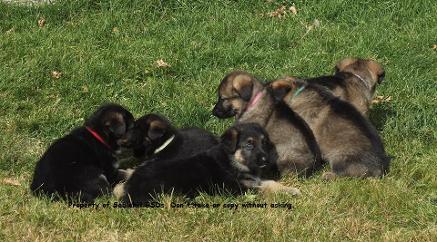
Aurora's 2015 Litter
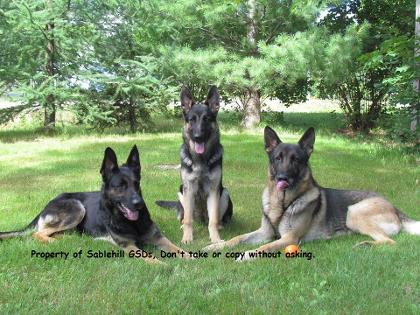
Family Photo, Chessa (Dam), Aurora (Daughter),
and Wolf (Sire). Aug 19 2013
German Shepherd Dogs
This is the standard of the breed set out by the CKC ( Canadian Kennel Club). In this standard it describes what the breed should be like. In breeding we as responsible breeders follow these outlines and pick dogs that are best fit the breed standards. Not only to produce the ideal German Shepherd Dog but to help in preserve the breed as a breed.
The German Shepherd Breed Standard;
General Appearance: First impression of a good German Shepherd Dog is that of a
strong, agile, well-muscled animal, alert and full of life. It should both
be and appear to be well balanced, with harmonious development of
the forequarter and hindquarter. The dog should appear to the eye,
and actually be, longer than tall, deep bodied, and present an outline of
smooth curves rather than corners. It should look substantial and not
spindly, giving the impression both at rest and in motion of muscular
fitness and nimbleness without any look of clumsiness or soft living. The Shepherd should be stamped with a look of quality and nobility,
difficult to define but unmistakable when present. The good German
Shepherd Dog never looks common.
Secondary sex characteristics should be strongly marked, and every
animal should give a definite impression of masculinity or femininity,
according to its sex. Dogs should be definitely masculine in appearance
and deportment; bitches, unmistakably feminine, without weakness of
structure or apparent softness of temperament.
The condition of the dog should be that of an athlete in good condition,
the muscles and flesh firm and the coat lustrous.
Temperament: The breed has a distinct personality marked by a direct and fearless,
but not hostile, expression, and self-confidence and a certain aloofness
which does not lend itself to immediate and indiscriminate friendships.
The Shepherd Dog is not one that fawns upon every new acquaintance.
At the same time, it should be approachable, quietly standing its
ground and showing confidence and a willingness to meet overtures
without itself making them. It should be poised, but when the occasion
demands, eager and alert, both fit and willing to serve in any capacity
as companion, watch dog, blind leader, herding dog or guardian;
whichever the circumstances may demand.
The Shepherd Dog must not be timid, shrinking behind its master or
handler, nervous, looking about or upward with anxious expression or
showing nervous reactions to strange sounds or sights, or lackadaisical,
sluggish, or manifestly disinterested in what goes on about him. Lack of confidence under any surroundings is not typical of good character.
Cases of extreme timidity and nervous unbalance sometimes give
the dog an apparent, but totally unreal, courage and it becomes a
“fear biter,” snapping not for any justifiable reason but because it
is apprehensive of the approach of a stranger. This is a serious fault
subject to heavy penalty.
Size: The ideal height for dogs is 25 inches (64 cm), and for bitches, 23
inches (58 cm) at the shoulder. This height is established by taking a
perpendicular line from the top of the shoulder blade to the ground
with the coat parted or so pushed down that this measurement will
show the only actual height of the frame or structure of the dog.
The working value of dogs above or below the indicated height is
proportionately lessened, although variations of an inch (3 cm) above
or below the ideal height are acceptable, while greater variations must
be considered as faults. Weights of dogs of desirable size in proper
flesh and condition average between 75 and 85 lb. (34 and 39 kg); and
of bitches, between 60 and 70 lb. (27 and 32 kg).
Coat: The Shepherd is normally a dog with a double coat, the amount of
undercoat varying with the season of the year and the proportion of the
time the dog spends out of doors. It should, however, always be present
to a sufficient degree to keep out water, to insulate against temperature
extremes, and as a protection against insects. The outer coat should be
as dense as possible, hair straight, harsh and lying close to the body. A
slightly wavy outer coat, often of wiry texture, is equally permissible.
The head, including the inner ear, foreface, and legs and paws are
covered with short hair, and the neck with longer and thicker hair. The
rear of forelegs and hind legs has somewhat longer hair extending to
the pastern and hock respectively. Faults in coat include complete lack
of any undercoat, soft, silky or too long outer coat and curly or open
coat.
Color: The German Shepherd Dog differs widely in color. Generally
speaking, strong, rich colors are to be preferred, with definite
pigmentation, and without appearance of a washed-out color. White
dogs are to be disqualified.
Head: Clean-cut and strong, the head of the Shepherd is characterized by nobility. It should seem in proportion to the body and should not be clumsy, although a degree of coarseness of head, especially in dogs, is less of a fault than over-refinement. A round or domey skull is a fault. The muzzle is long and strong with the lips firmly fitted, and its topline is usually parallel with an imaginary elongation of the line of the forehead. Seen from the front, the forehead is only moderately arched and the skull slopes into the long wedge-shaped muzzle without abrupt stop. Jaws are strongly developed. Weak and too narrow underjaws, snipey muzzles, and no stop are faults
Teeth: The strong teeth, 42 in number (20 upper and 22 lower) are strongly developed and meet in a scissors grip in which part of the inner surface of the upper teeth meets and engages part of the outer surface of the lower teeth. This type of bite gives a more powerful grip than one in which the edges of the teeth meet directly, and is subject to less wear. The dog is overshot when the lower teeth fail to engage the inner surfaces of the upper teeth. This is a serious fault. The reverse condition – an undershot jaw – is a very serious fault. While missing premolars are frequently observed, complete dentition is decidedly to be preferred. So-called distemper teeth and discolored teeth are faults whose seriousness varies with the degree of departure from the desired white, sound coloring. Teeth broken by accident should not be severely penalized but worn teeth, especially the incisors, are often indicative of the lack of a proper scissors bite, although some allowance should be made for age.
Eyes: The eyes of medium size, almond shaped, set a little obliquely and not protruding. The color as dark as possible. Eyes of lighter color are sometimes found and are not a serious fault if they harmonize with the general coloration, but a dark brown eye is always to be preferred. The expression should be keen, intelligent, and composed.
Ears: The ears
should be moderately pointed, open towards the front, and are carried
erect when at attention, the ideal carriage being one in which the center lines of the ears, viewed from the front, are parallel to each other and
perpendicular to the ground. Puppies usually do not permanently raise
their ears until the fourth or sixth month, and sometimes not until
later. Cropped and hanging ears are to be discarded. The well-placed
and well-carried ear of a size in proportion to the skull materially adds
to the general appearance of the Shepherd. Neither too large nor too
small ears are desirable. Too much stress, however, should not be laid
on perfection of carriage if the ears are fully erect.
Neck: The neck is strong and muscular, clean-cut and relatively long,
proportionate in size to the head and without loose folds of skin. When
the dog is at attention or excited, the head is raised and the neck carried
high, otherwise typical carriage of the head is forward rather than up
and but little higher than the top of the shoulder, particularly in motion.
Body: The whole structure of the body gives an impression of depth and
solidity without bulkiness. Forechest, commencing at the prosternum,
should be well filled and carried well down between the legs with no
sense of hollowness. Chest should be deep and capacious with ample
room for lungs and heart. Well carried forward, with the prosternum,
or process of the breastbone, showing ahead of the shoulder when
the dog is viewed from the side. Ribs should be well sprung and long,
neither barrel shaped nor too flat, and carried down to a breastbone
which reaches to the elbow. Correct ribbing allows the elbow to move
back freely when the dog is at a trot, while too round a rib causes
interference and throws the elbow out. Ribbing should be carried well
back so that loin and flank are relatively short. Abdomen firmly held
and not paunchy. The bottom line of the Shepherd is only moderately
tucked up in flank, never like that of a Greyhound.
Legs: The bone of the legs should be straight, oval rather than round or flat,
and free from sponginess. Its development should be in proportion
to the size of the dog and contribute to the overall impression of
substance without grossness. Crooked leg bones and any malformation
such as, for example, that caused by rickets, should be penalized.
Pastern should be of medium length, strong and springy. Much more
spring of pastern is desirable in the Shepherd Dog than in any other
breeds, as it contributes to the ease and elasticity of the trotting gait.
The upright terrier pastern is definitely undesirable.
Metatarsus (the so-called “hock”): short, clean, sharply defined, and
of great strength. This is the fulcrum upon which much of the forward
movement of the dog depends. Cow-hocks are a decided fault, but
before penalizing for Cow-hocks, it should be definitely determined,
with the animal in motion, that the dog has this fault, since many dogs
with exceptionally good hindquarter angulation occasionally stand so as
to give the appearance of cow-hockedness which is not actually present.
Feet: Rather short, compact, with toes well arched, pads thick and hard, nails
short and strong. The feet are important to the working qualities of the
dog. The ideal foot is extremely strong with good gripping power and
plenty of depth of pad. The so-called cat-foot, or terrier foot, is not
desirable. The thin, spread or hare-foot is, however, still more undesirable.
Topline: The withers should be higher than, and sloping into, the level back to
enable a proper attachment of the shoulder blades. The back should be
straight and very strongly developed without sag or roach, the section
from the wither to the croup being relatively short. (The desirable
long proportion of the Shepherd Dog is not derived from a long back
but from overall length with relation to height, which is achieved by
breadth of forequarter and hindquarter viewed from the side.) Loin:
viewed from the top, broad and strong, blending smoothly into the
back without undue length between the last rib and the thigh, when
viewed from the side. Croup should be long and gradually sloping. Too
level or flat a croup prevents proper functioning of the hindquarter,
which must be able to reach well under the body. A steep croup also
limits the action of the hindquarter.
Structure: A German Shepherd is a trotting dog and his structure has been developed
to best meet the requirements of his work in herding. That is to say, a long,
effortless trot which shall cover the maximum amount of ground with the
minimum number of steps, consistent with the size of the animal. The
proper body proportion, firmness of back and muscles and the proper
angulation of the forequarters and hindquarters serve this end. They
enable the dog to propel itself forward by a long step of the hindquarter
and to compensate for this stride by a long step of the forequarter. The
high withers, the firm back, the strong loin, the properly formed croup,
even the tail as balance and rudder, all contribute to this same end.
Proportion: The German Shepherd Dog is properly longer than tall with the most
desirable proportion as 10 is to 8-1/2. We have seen how the height
is ascertained; the length is established by a dog standing naturally
and four-square, measured on a horizontal line from the point of the
prosternum, or breastbone, to the rear edge of the pelvis, the ischium
tuberosity, commonly called the sitting bone.
Angulation: Forequarter: the shoulder blade should be long, laid on flat against the
body with its rounded upper end in a vertical line above the elbow,
and sloping well forward to the point where it joins the upper arm.
The withers should be high, with shoulder blades meeting closely at
the top, and the upper arm set on at an angle approaching as nearly
as possible a right angle. Such an angulation permits the maximum
forward extension of the foreleg without binding or effort. Shoulder
faults include too steep or straight a position of either blade or upper
arm, too short a blade or upper arm, lack of sufficient angle between
these two members, looseness through lack of firm ligamentation, and
loaded shoulder with prominent pads of flesh or muscles on the outer
side. Construction in which the whole shoulder assembly is pushed too
far forward also restricts the stride and is faulty.
Hindquarters: The angulation of the hindquarter also consists ideally of a series
of sharp angles as far as the relation of the bones to each other is
concerned, and the thigh bone should parallel the shoulder blade while
the stifle bone parallels the upper arm. The whole assembly of the
thigh, viewed from the side, should be broad, with both thigh and stifle
well muscled and of proportionate length, forming as nearly as possible
a right angle. The metatarsus (the unit between the hock joint and the
foot commonly and erroneously called the hock) is strong, clean and
short, the hock joint clean-cut and sharply defined.
Tail: Bushy, with the last vertebra extended at least to the hock joint, and usually
below. Set smoothly into the croup and low rather than high, at rest the
tail hangs in a slight curve like a sabre. A slight hook – sometimes carried
to one side – is faulty only to the extent that it mars general appearance.
When the dog is excited or in motion, the curve is accentuated and the tail
raised, but it should never be lifted beyond a line at right angles with the
line of the back. Docked tails, or those which have been operated upon
to prevent curling, disqualify. Tails too short, or with clumpy end due to
the ankylosis or the growing together of the vertebrae, are serious faults.
Gait: The gait of the German Shepherd Dog is
outreaching, elastic, seemingly without effort, smooth and rhythmic. At a
walk it covers a great deal of ground, with long step of both hind leg and foreleg. At a trot, the dog covers still more ground and moves powerfully
but easily with a beautiful co-ordination of back and limbs so that, in
the best examples, the gait appears to be the steady motion of a welllubricated
machine. The feet travel close to the ground, and neither fore
nor hind feet should lift high on either forward reach or backward push.
The hindquarter delivers, through the back, a powerful forward thrust
which slightly lifts the whole animal and drives the body forward. Reaching
far under, and passing the imprint left by the front foot, the strong arched
hind foot takes hold of the ground; then hock, stifle, and upper thigh come
into play and sweep back, the stroke of the hind leg finishing with the foot
still close to the ground in a smooth follow-through. The overreach of the
hindquarter usually necessitates one hind foot passing outside and the
other hind foot passing inside the track of the forefeet and such action is
not faulty unless the locomotion is crabwise with the dog’s body sideways
out of the normal straight line. In order to achieve ideal movement of this
kind, there must be full muscular co-ordination throughout the structure
with the action of muscles and ligaments positive, regular and accurate.
Back Transmission: The typical smooth, flowing gait of the Shepherd Dog cannot be
maintained without great strength and firmness (which does not mean
stiffness) of back. The whole effort of the hindquarter is transmitted
to the forequarter through the muscular and bony structure of the
loin, back, and withers. At full trot, the back must remain firm and
level without sway, roll, whip or roach. To compensate for the forward
motion imparted by the hindquarter, the shoulder should open to its
full extent – the desirability of good shoulder angulation now becomes
apparent – and the forelegs should reach out in a stride balancing that
of the hindquarter. A steep shoulder will cause the dog either to stumble
or to raise the forelegs very high in an effort to co-ordinate with the
hindquarter, which is impossible when shoulder structure is faulty. A
serious gait fault results when a dog moves too low in front, presenting
an unleveled topline with the wither lower than the hips. The Shepherd
Dog does not track on widely separated parallel lines as does the terrier,
but brings the feet inward toward the middle line of the body when at
trot in order to maintain balance. For this reason a dog viewed from the
front or rear when in motion will often seem to travel close. This is not
a fault if the feet do not strike or cross, or if the knees or shoulders are
not thrown out, but the feet and hocks should be parallel even if close
together. The excellence of gait must also be evaluated by viewing from
the side the effortless, properly coordinated covering of ground.
It should never be forgotten that the ideal Shepherd is a working
animal which must have an incorruptible character combined with
body and gait suitable for the arduous work which constitutes its
primary purpose. All its qualities should be weighed in respect to
their contribution to such work, and while no compromise should
be permitted with regard to its working potentiality, the dog must
nevertheless possess a high degree of beauty and nobility.
Evaluation of Faults Note: Faults are important in the order of their group, as per group headings, irrespective of their position in each group. Very Serious Faults Major faults of temperament; undershot lower jaw. Serious Faults Faults of balance and proportion; poor gait, viewed either from front, rear or side; marked deficiency of substance (bone or body); bitchy male dogs; faulty backs; too level or too short croup; long and weak loin; very bad feet; ring tails; tails much too short; rickety condition; more than four missing premolars or any other missing teeth, unless due to accident; lack of nobility; badly washed-out color; badly overshot bite. Faults Doggy bitches; poorly carried ears; too-fine in head; weak muzzles; improper muscular condition; faulty coat, other than temporary condition; badly affected teeth. Minor Faults Too coarse head; hooked tails; too light, round or protruding eyes; dis-colored teeth; condition of coat, due to season or keeping. Disqualifications Albino characteristics; cropped ears; hanging ears (as in a hound); docked tails; male dogs having one or both testicle undescended (monorchids or cryptorchids); white dogs.
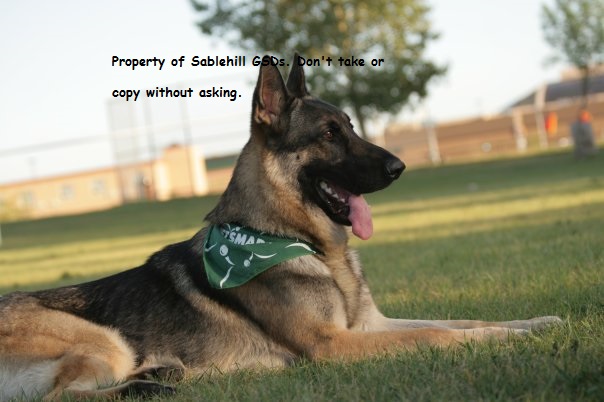
Styles and types of German Shepherd Dogs within the Breed
In addition to each club having a standard there is also something to consider when looking for a breeder. One needs to understand the breed as a whole and also the different variations within the breed. The German Shepherd Dog as been bred over the years in different parts of the world and thus there are slightly different variations out there. Each with it's own style. These variations all look like and are recognized as German Shepherd Dogs only with a few thing that sets them slightly apart. The average person will not notice these differences as breeders and breed enthusiasts do.These variations where purposely bred to have either higher drives, high energy, high eagerness to work, lighter in body, bred for temperament, for movement and conformation and so forth. The German Shepherd Dog is known for being so versatile that it can and will do mostly any job you ask and train them to do. When looking to add a puppy or dog to your family you need to know what your family life style is.
Are you an outdoor active family or a moderate family? Do you have children and or are you single and so fourth?
To understand the breed and help make the right choice research is the key.
Here are the Variation within the German Shepherd Dog and a bit about them to help you see the variations within this wonderful breed.
American Showline and Canadian Showline;
The ones seen the most in North American in the Dog Show World. Shows like Westminster kennel Club Dog Show on tv. American and Canadian showlines Glorify the kennel clubs Shows. They follow the Breed Standards set by the Parent Clubs in Canada and the United States. The standard is shared above. Breeders of this Style are looking for a balanced dog, Both in body and mind.
Here a Sablehill GSDs I personally love this variation the most, and thus I breed to the Showline Standards set by the Canadian Kennel Club that the German Shepherd Dog Club of Canada has given CKC. I find the temperament of this style the easiest to work and train, they are easily satisfied in play, light work, active home lifestyle and trick training, a hike and companionship. Most are medium-drive, great as a family dog. Still need to be exercised as with all of the variations of the German Shepherd Dog, just easier to meet their needs. Very loyal and still have the herding instincts of the breed, and can still work and do the job they where originally breed for. I breed to have a versatile working dog. Showlines can still do Agility, Herding, Rally, Obedience.
Yes Some will argue that show-lines can't but I have seen and had many that will, after all the over all German Shepherd Dog is a versatile working dog.
West German Showline (WGSL);
In Germany, this is the most popular Style of German Shepherd seen. They are bred to the SV Breed standard. Breeders of this Style must have SV rating for hips and elbows, also have Show and Working title befor they can breed and Register a litter. Titles are mostly seen as Conformation Show Champion, IPO and Herding. Its very easy to tell this line of GSD form the others as they do look abit different. They are often mostly seen in Black and Red saddle back. Sables and Soild Blacks are also out there too. They come in a plush or long coat. WGSL are a strong line of German Shepherd and need a strong owner as they are known to have higher Drives.
West German Working Lines (WGWL);
The West German workinglines are focused on hardcore working ability. Being of solid temperament and strong working drives. West German workinglines are amazing in a number of different K9 sports, like IPO, IGP and Schultzhund. The WGWL is not as uniform as the WGSL in there are a few things that are allowed that are not in the WGSL. WGWL can come in more colors such as( Black/Tan, Black, Black/Red, Sable, Bi-color), they are also more compacted, agile and athletic. Often recommended for active sport homes.
DDR / East German Working Lines;
This style came around after WW-II from War dogs. DDR / East German dogs were kept under strict guidelines by the government of East Germany. Thus this strict control of this Line of GSD produced a sharp unmistakable type.They are known for having very good/high prey drive and hunt drive making them very eager to do what is asked of them. DDR/ East German Lines bond strongly and are attached to their family and aloof with strangers. Foundation stock/Orginal Pedigrees of this Style are highly prized in East Germany. known to be of outstanding temperments and Genes. Another Style that is best for an Active Sport Home.
Czech Working Lines;
Czechoslovakia is were this Style was created. Bred form Dogs used mainley as working dogs along with Border Patrol Officers. The main Kennel of this type of GSD is out of Czechoslovakian Army’s Pohranicni Straze kennel. Czech lines are known for working drives, they are intense, agile, strong working dogs. These dogs are not for the non-active person or family. They need both physical and mental work. Czech Working lines are known to be very high energy and high drives, willing and eager. And do best in a Active Sport/Competitive home.
Now that you have read some info on the types within the German Shepherd Dog breed. You should have a better understanding of the breed and what might fit into your lifestyle the best.
All in all the German Shepherd Dog is a very unique and versatile breed. They are very affectionate, loyal, and great family dogs. They are my passion and I will always have them in my home as members of my family. My children will grow up raised with this wonderful breed.
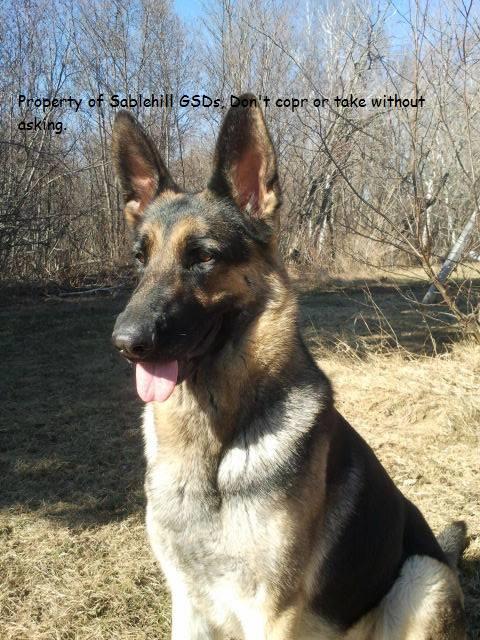
Miss Aurora 2015
Grooming German Shepherd Dogs
As a Professional Groomer I know the proper way to groom German Shepherd Dogs as well as other breeds. Here is great info on what to use and how to groom your German Shepherd Dog, and what not to do and not to use.
German Shepherd Dogs are known for being huge shedders. They shed massively in the Spring and Fall. During this time they blow out all the under coat, and it clumps up in the coat and is very noticeable. If not brushed it can mat up. They also shed regularly year round. And need to be brushed out regularly at least once or twice a week.
German Shepherd Dogs are double coated dogs. Meaning they have two types of fur. Their coat is a combination of straight and short to moderate length fur. The outer guard coat is harsh to touch, while abundant soft down under coat is think and dense to protect the dogs in extreme weather. From hot to warm and extreme cold. Their coat keeps them from over heating, sunburns, and form freezing.
German Shepherd Dogs are not to be SHAVED!!, this does not help with the shedding at all. All it dose is shorten the fur, it will still shed! Shaving can and does in fact cause more problems then good. First off if you shave them they are more prone to sunburns and over heating. Heat stokes can and do happen in dogs just like us. Only it is worse for dogs then us. Dogs do not sweat, they pant to cool down and their coats help repels the sun and heat. As said above the coat protects them. Shaving them causes coat damage. The coat will not grow back in the same and the more times its shaved the more the damage will start to show. By damage I mean the coat will start to grow in patches, sometimes thick in some spots and thin in others, and or might not grow back fully at all. It can and some have it come back wirery, dry or fuzzy and oily, each dog is going to have damage a bit different. As a groomer I seen this all first hand. There are breeds yes that can be shaved they are single coated though, not double coated. They have no under coat and the fur is meant for trims and can be shaved. German Shepherd Dogs and all other double coated dogs are not. I do not shave my dogs and never will, I request and have it in my contract that all my dogs are not to be shaved.
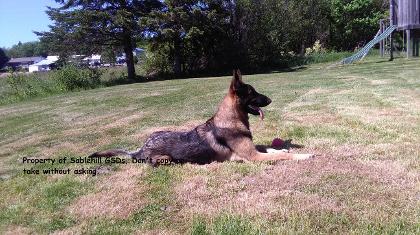
Maverick May 31 2016
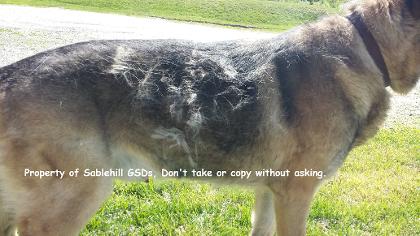
Wolf going through a shed, and being brushed.
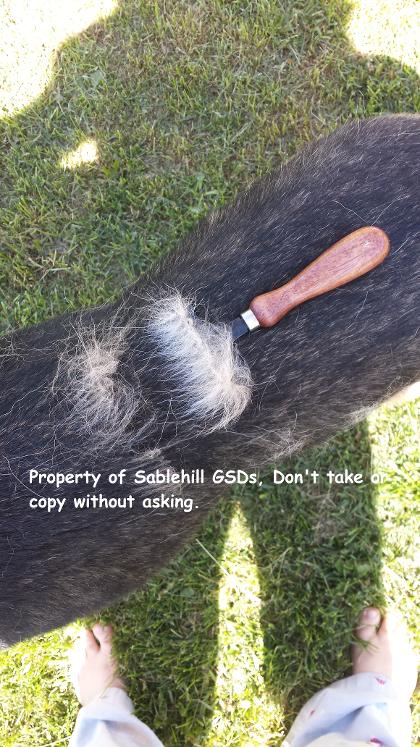
Wolf being brushed- I have three favorite brushes. This is the rake. I find it gets a lot of the under coat out and it don't take long to do a nice brush out.
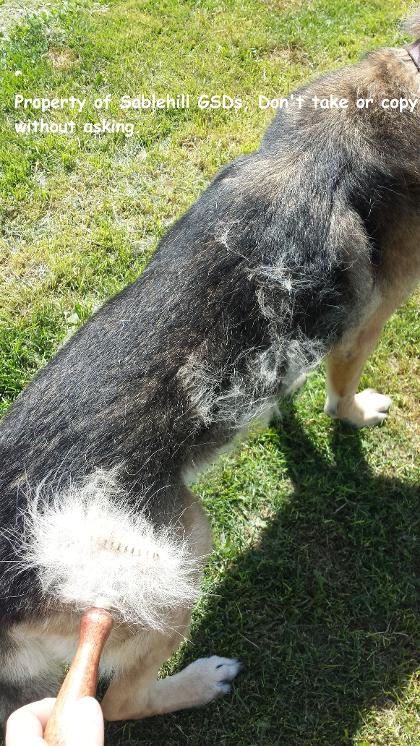
The rake brush used on my boy Wolf. It works wonderfully in the rear area and the thighs.
I groom my Dogs once a month unless we are at a Show or Trail. They get fully washed, shampooed, and dried with my Velocity Dryer. This helps keep their coat in good condition and helps with the fur all over the house.
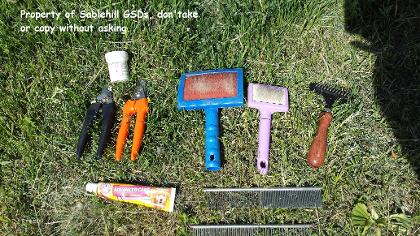
Grooming tools to use on a German Shepherd Dog.
Greyhound Comb
Rake
Curved Slicker Brush
Rubber Brush (not pictured)
Pin Brush (not pictured)
Nail Clippers and Styptic Power or Quick Stop
Enzymatic Toothpaste for dogs. I brush my dogs teeth once a week. Also raw bones really help with cleaning their teeth too.
Ear Cleaning solution and facial cleaning pads
(not pictured)
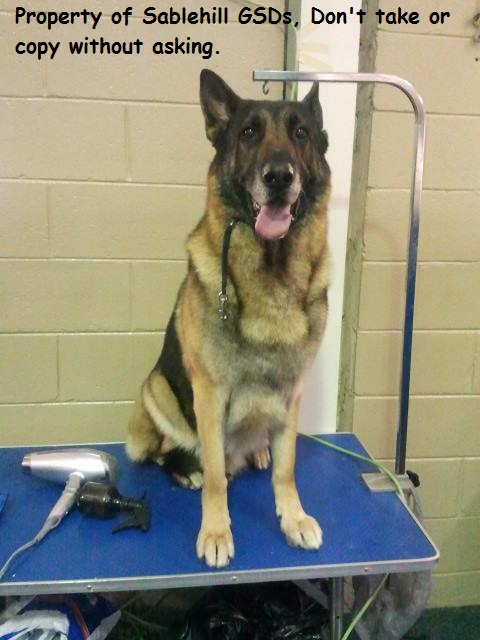
Wolf at the dog show April 1 2016
Brushing your German Shepherd on a regular base will keep the shedding low and help keep the skin and coat healthy. Brushing helps move and stimulate the skin to grow healthy fur and produce oils naturally. Bathing every few months is all that is needed unless your dog gets really dirty or swims in the lake or pond. I will bath mine if they go in the lake or ponds. As in the water there are tiny insects and bacteria that can irritate the skin and cause your dog to scratch and chew themselves a lot and cause sores.
Brushing with a slicker brush, pin brush, or comb will pull the loose under coat out. Allowing the air to circulate through the coat helping to cool your dog down on warm days. It stimulate growth and keep them from matting. A healthy coat will have a shine and a glossy look too it. You can run your hand through and feel a nice clean coat. Care is needed when brushing with a metal teeth or bristled brush, as if you use too much force or push down on the brush too heavy or over brush in one area you can cause brush burn and or cut your dogs skin. Brushing and combing is not finished until all loose fur is out during massive shedding periods. The areas that hold in the coat more are the chest, neck, shoulders, and rear. Let your hands feel for differences in the areas and learn to feel heavier or denser spots than others. Those spots still have under coat and will need more drying time after a bath with the blow dryer or velocity dryer. Hot spots will occur if you don't brush out the under coat or blow dry(on Cool or Cold, never use a hair dry on a dog on warn or hot, u can make them over heat) after a bath.
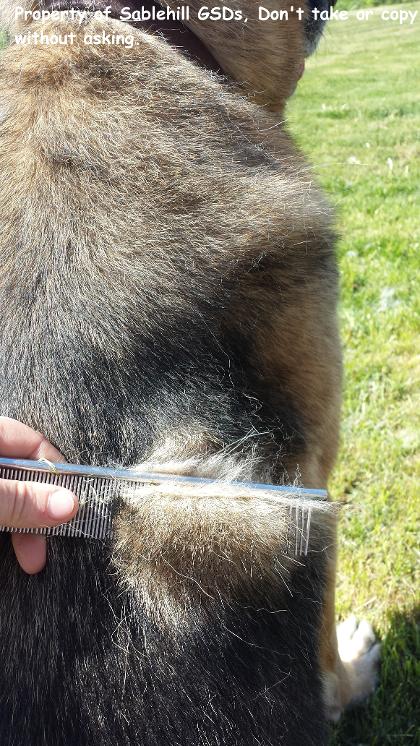
The next is the comb, I love my Combs, it also gets a good amount of under coat out in a shedding period.
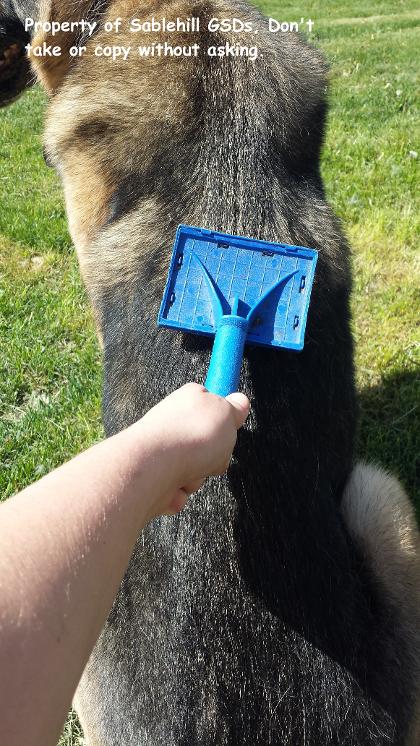
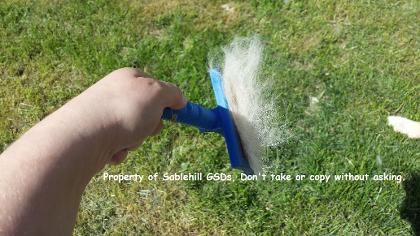
This is my curved slicker brush, and it works amazingly.